

Anyone who’s tried to get picked up at airports such as LAX knows the feeling: you step off a long flight, follow the crowds outside, and are immediately met with honking traffic, looping shuttles to remote rideshare lots, and Uber or Lyft queues that barely move. It’s a chaotic way to start or end a trip, but it’s an experience many travelers know far too well.
Almost half of U.S. travelers say that organizing airport transfers is the most stressful part of any journey.1 After hours in the air, nobody wants to figure out confusing kerbside rules, trek to distant pickup zones, or juggle unexpected fees just to meet their ride.
So we set out to understand which airports make arrivals smooth, and which turn it into an obstacle course. We analyzed the world’s busiest airports and scored them on the factors that actually matter when you land, from rideshare access and shuttle transfers to kerbside design and public transport connections.
The result is a clear look at the airports where meeting your ride is quick and intuitive…and the ones where it pays to plan ahead.
Compare taxis, shuttles, and private transfers in one place. One search. No guesswork. Full support.
Get your airport transfer now
Every airport works differently when it comes to pickups, which makes it hard for travelers to know what to expect before they land. So, we set out to compare how easy it is to meet your ride at the world’s 50 busiest airports.
To do this, we focused on the three factors that make the biggest impact when you step out of arrivals.
Some airports allow taxis and ridesharing services to pull directly up to the curb. Others redirect them to dedicated lots, limit access at specific terminals, or require a shuttle connection.
Airports with simple, flexible rules scored higher.
Extra charges can turn a straightforward pickup into an unexpectedly pricey one. We compared the fees added to taxi and rideshare trips at each airport and scored them based on how affordable they are for travelers.
Once you collect your luggage, how far do you have to go? Airports scored well when their pickup zones were conveniently located near the terminal, clearly signposted, and didn’t require long walks or additional transportation.
Each airport received a score out of five for all three categories. These were then combined into an overall score out of 15 and grouped into five tiers:
North and South America include some of the easiest airports in the world for pickups, as well as some of the trickiest.
Several major airports in Mexico and the United States earn “excellent” scores thanks to simple curb access and predictable rules, making it easy for friends, family, taxis or rideshares to meet arriving passengers.
Yet, within the same region, other airports fall into the lower tiers, often due to remote pickup zones, added fees, or longer walks from the arrivals area.
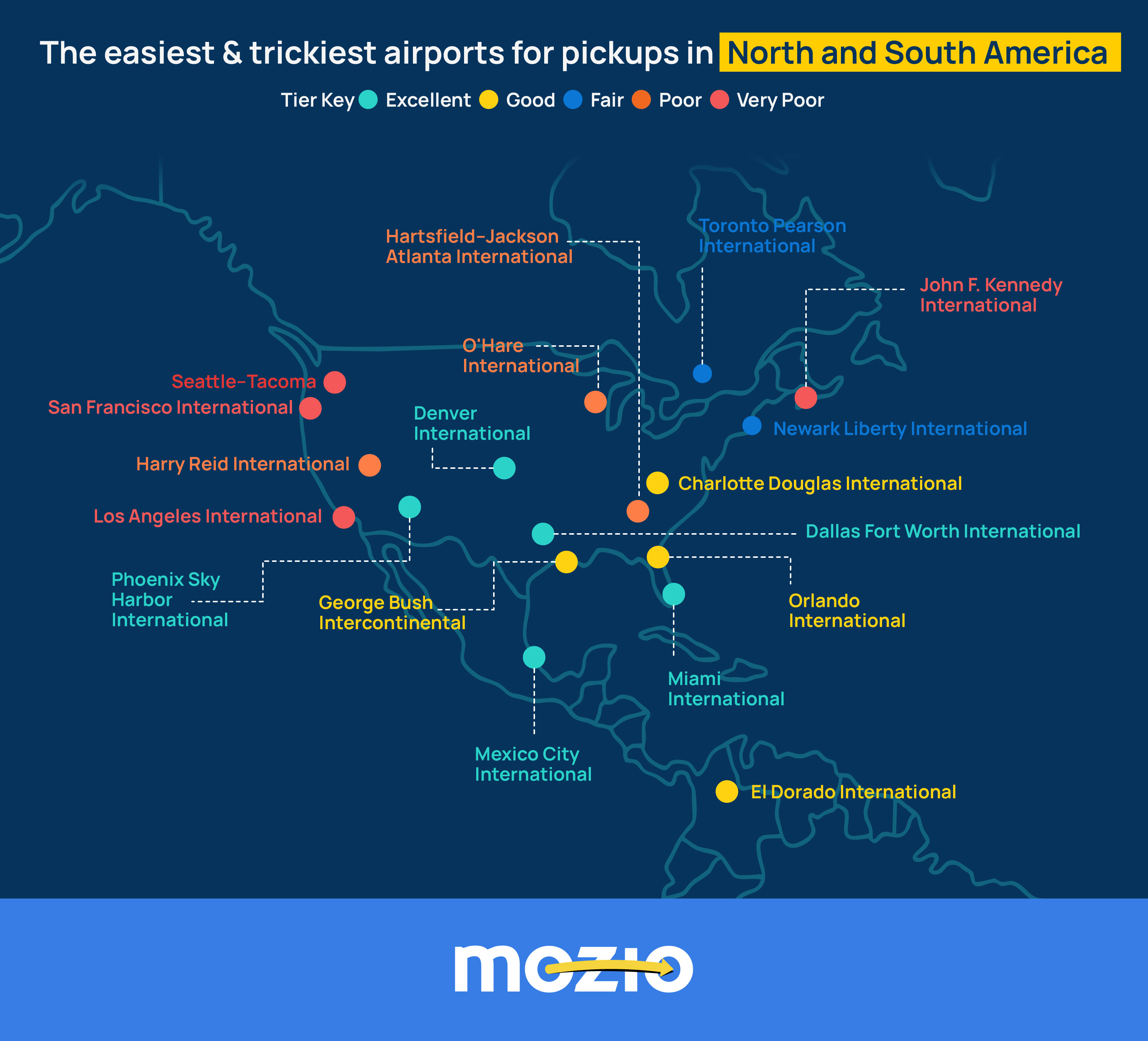
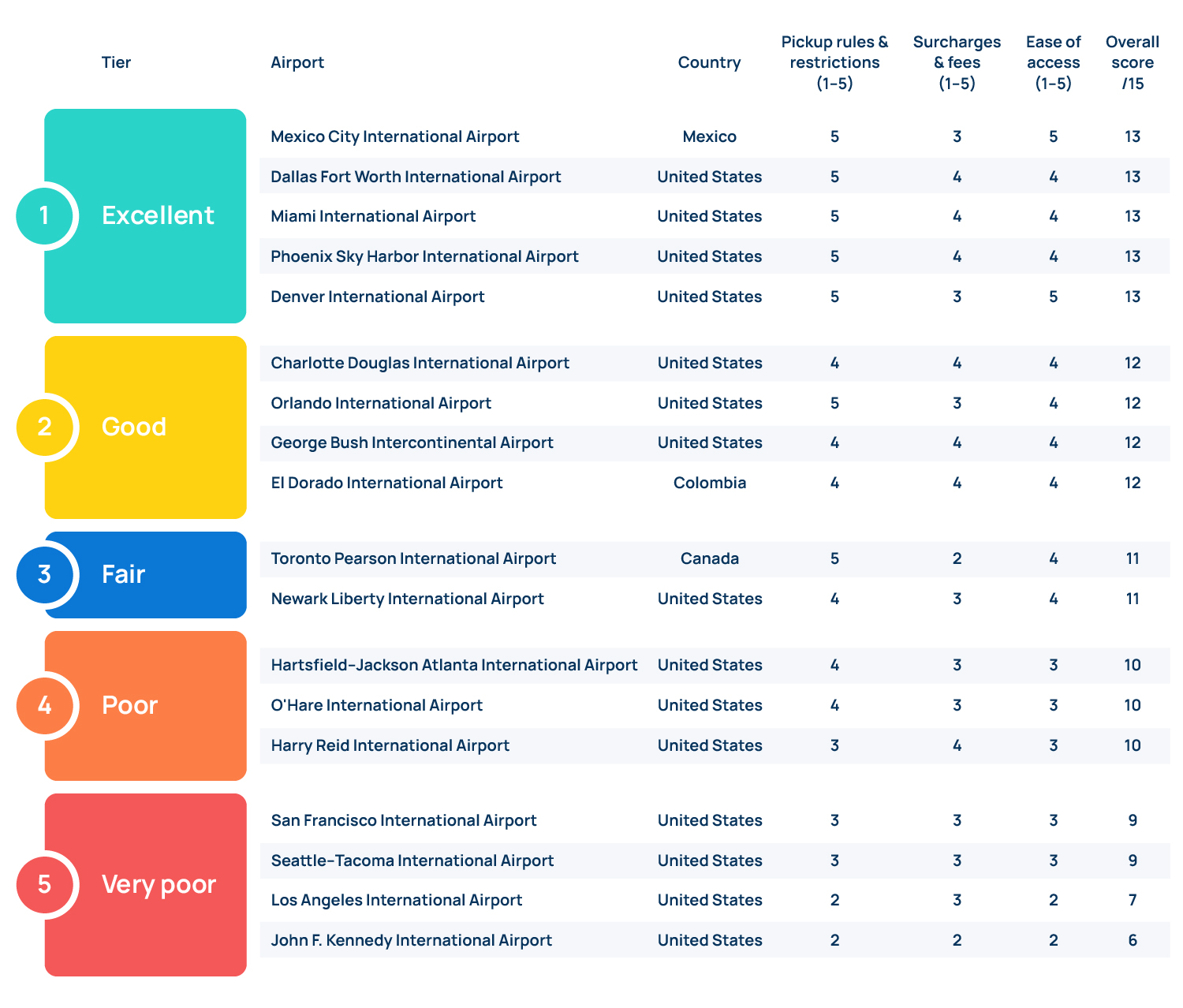
Airports in the “excellent” tier offer the smoothest pickup experience in North and South America. Although these locations differ in size, layout, and passenger volume, they all maintain a simple process: curbside access is widely available, surcharges remain manageable, and pickup points are easily accessible once you exit the arrivals area.
Five airports made it into this tier:
All airports allow taxis to wait at the curb outside all terminals, but only Mexico City International Airport and Denver International Airport also permit pickups directly outside the arrivals area.
Denver also offers one of the widest selections of onward travel options in the region, including rideshares, shuttles, limousines, commuter buses, charter services and hotel shuttles, which are all accessible directly from Level 5.2
Airports in the “good” tier generally offer a smooth pickup experience, with only a few minor limitations that prevent them from reaching the top tier. Most limitations are minor – a slightly longer walk here, a small surcharge there – but nothing that significantly slows passengers down.
Four airports fall into this tier:
Orlando International Airport serves over 57 million passengers annually, making it one of the busiest airports in the United States.3 That family-heavy leisure traffic means curbside areas are constantly busy, yet Orlando still performs well in this report thanks to clear wayfinding, short walks from baggage claim and a pickup layout that keeps different transport modes separated but close.
Airports in the “fair” tier have workable pickup processes, but passengers may encounter a few extra steps compared to the higher-scoring places. Walking distances can be longer, pickup zones may be split across multiple areas, or rideshares may be directed slightly farther from the terminal than taxis.
Two airports fall into this tier:
Both airports allow curbside taxi access across their terminals, but rideshare pickups are typically located in designated areas that may require a short walk. This setup helps manage vehicle flow at busy terminals, but can add a few minutes for passengers meeting their ride.
Toronto Pearson International Airport, Canada’s busiest airport, saw passenger volumes rise to 46.8 million in 2024, with international travel leading that growth.4 Pearson is investing in expansion plans to support future demand, but in the short term, the size of the airport and the split between curbside taxi access and slightly more remote zones mean passengers may need to walk farther or follow more signage than at top-tier hubs.
Airports in the “poor” tier offer less convenient pickups, often due to busier layouts, more restrictive rules, or pickup points that sit farther from the arrivals area. Travelers can still navigate the process, but it usually requires a bit more time, attention, and planning, especially during busy periods or at larger terminals.
Three airports fall into this tier:
Hartsfield–Jackson Atlanta International Airport has retained its position as the congested airport in the world by total passengers, according to Airports Council International’s (ACI) traffic rankings.5
Managing that many arrivals inevitably puts strain on the curb, which is reflected in this report through longer walks to rideshare areas and more complex traffic management around the terminals.
“Very poor” airport pickups present the biggest challenges for passengers trying to meet their ride. These places tend to have the most restrictive pickup rules and layouts that require longer walks or additional steps before reaching the correct pickup point. For tired travelers or those unfamiliar with the airport, the process can feel slow and less intuitive.
Four airports fall into this tier:
San Francisco International Airport handled about 51.3 million passengers in the 2023–24 fiscal year and has been investing heavily in new infrastructure, including a Terminal 3 West modernization program and the completion of the energy-efficient Harvey Milk Terminal.6
Those upgrades are designed to improve the passenger experience, but while work is ongoing, pickups can involve longer walks, temporary signage and more complex navigation between construction zones and ground transport areas.
Asia stands out as the strongest-performing region in the entire report, with more airports earning “excellent” scores than anywhere else in the world.
Many major airports keep things calm and straightforward, offering low fees, flexible pickup rules, and pickup points positioned just a short, clearly marked walk from the terminal. Across much of the region, airports feel designed with tired travelers in mind, making it easy to connect with your ride and start your onward journey without stress.

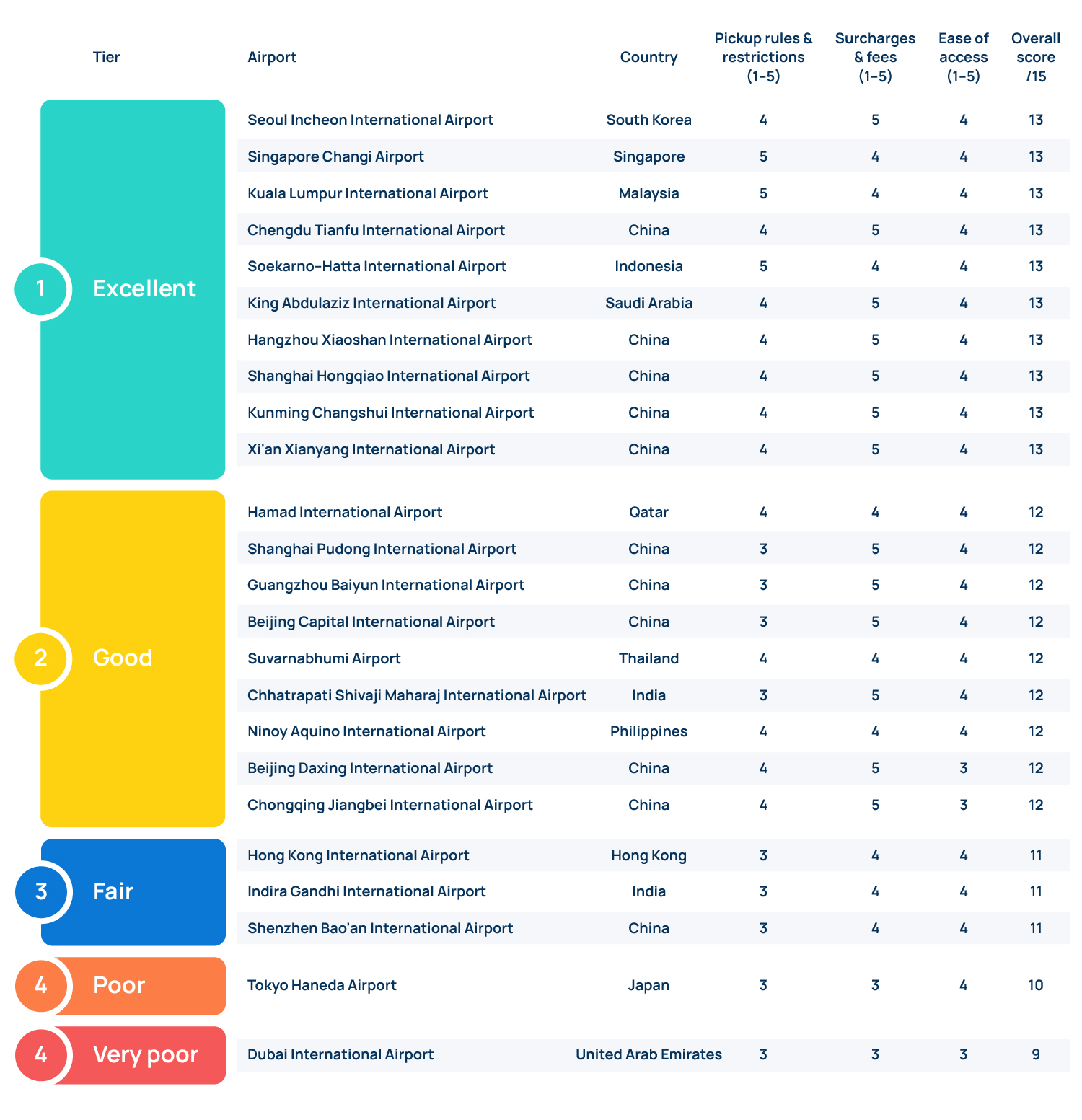
Asia has the largest group of airports in the “excellent” tier, at 10 in total:
Several of these airports offer thoughtful touches that help make pickups feel calm and predictable for arriving passengers.
Singapore Changi Airport is a good example of this in practice.
Its pickup points are clearly designated across all terminals, with separate areas for taxis. These locations are consistently signposted and easy to find, which helps travelers move smoothly through the arrivals area.
Several major locations fall into the “good” tier in Asia, including:
A number of these airports are very large, which can mean passengers need to follow more steps or walk slightly farther to reach the correct pickup zone.
Hamad International Airport in Doha handled 52.7 million passengers in 2024, a 15% increase year-on-year.7 The airport’s recent expansion added 17 new contact gates and increased capacity to more than 65 million passengers annually, reducing reliance on remote stands and bus transfers for arriving flights.8
This helps streamline the walk from the aircraft to immigration and onward to ground transport, keeping pickup areas flowing even during peak periods.
Three of the busiest airports in Asia are rated as “fair”. Pick-ups from here are usually still manageable, though the overall process may feel less streamlined than at higher-scoring hubs.
Hong Kong International Airport has just commissioned its Three-Runway System, which is designed to allow the airport to handle up to 120 million passengers a year.9 That extra capacity will help the airport manage growth and maintain its role as a major Asian hub, but it also spreads arrivals and ground transport over a wider footprint, so pickups could involve more steps than at smaller airports in this region.
Tokyo Haneda is the only Asian airport in the “poor” tier, which shows how strong the region is overall.
The airport manages very high passenger volumes each year and operates across several multi-level terminals.10 Taxis remain straightforward to access, but rideshare services are directed to separate zones that require passengers to follow multiple routes. This layout keeps traffic organized at such a busy airport, yet it results in a less direct pickup experience compared with the region’s top performers.
Dubai International Airport is among the most successful long-haul locations, but ranks “very poor” in this specific pickup index. According to ACI figures, the airport handled approximately 92.3 million passengers in 2024, setting a new record for the location.11
Despite its global success, the scale of DXB places constant pressure on its road system and forecourts. Very high passenger volumes naturally mean more vehicles, heavier congestion and tighter controls on where rideshare services can stop. To keep traffic moving, the airport relies on designated pickup areas that are often located farther away compared to smaller airports.
Airport pickups in Europe can feel very different depending on where you land, with country-specific infrastructure and ways of organizing aviation. Some airports make it simple to step outside and meet your ride, with clear instructions and well-positioned pickup zones. Others require a little more navigation, thanks to larger layouts or busier forecourts.
One of the most surprising findings in the entire report is that not a single European airport reaches the “excellent” tier. Europe is home to some of the world’s most advanced airports, yet none offer the same level of pickup convenience seen across Asia or the Americas.

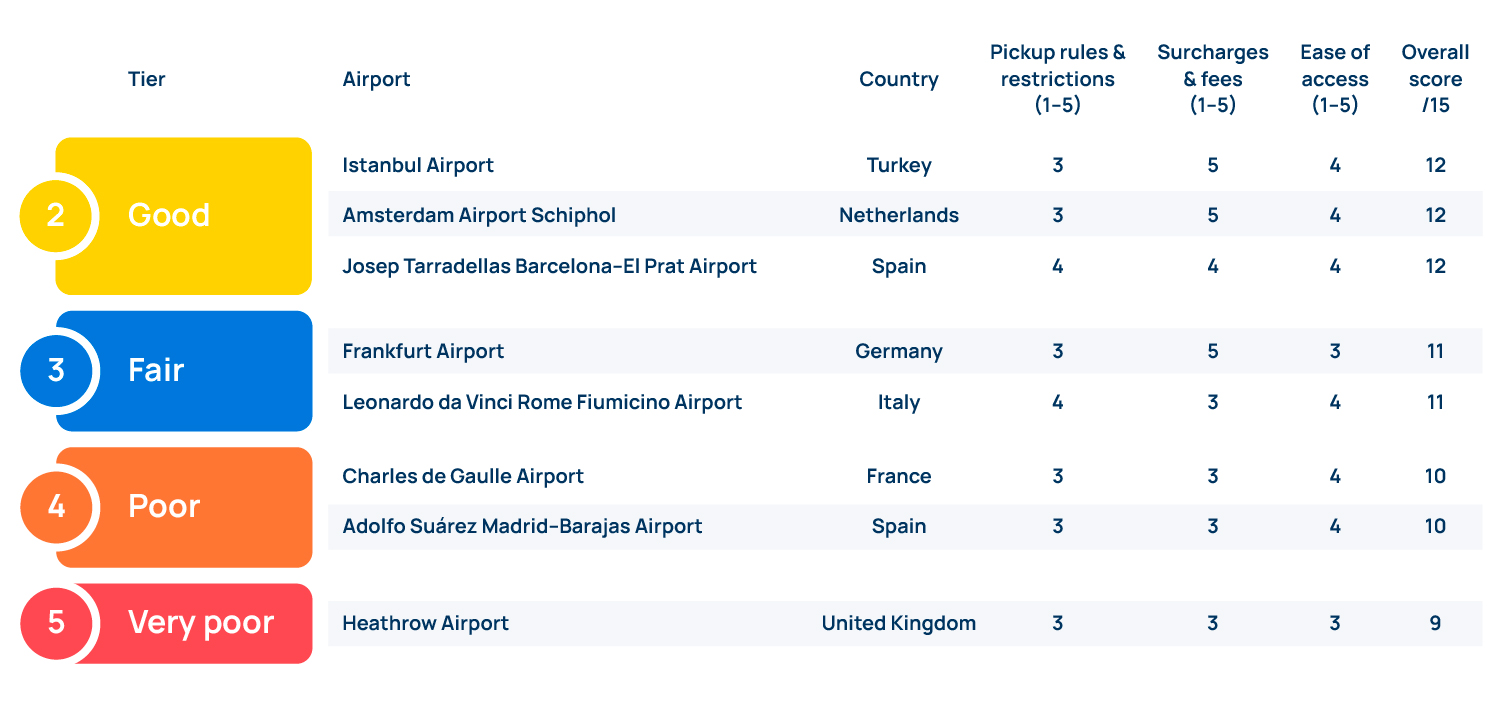
Several European airports sit in the “good” tier, offering reliable pickup experiences even if they don’t quite reach the standards set by the top-performing regions.
Three airports fall into this group:
These airports show that it is possible to balance scale with relatively simple pickups, and Istanbul Airport is a prime example. It handled around 80 million passengers in 2024, which made it Europe’s second-busiest airport.12
To handle this high number of passengers, Istanbul Airport benefits from multiple ground-transport options, including dedicated taxi pick-up areas outside the arrivals terminals.
Frankfurt and Rome Fiumicino sit in Europe’s “fair” tier, where reasonably clear instructions soften large, complex layouts. Frankfurt Airport welcomed approximately 6.1 million passengers in a single month.13
Its two main terminals and extensive road network mean that passengers often need to cross multiple outside areas before reaching their pickup zone, especially at peak times, which is why it scores lower on ease of access, even though signage is strong.
Rome Fiumicino has experienced significant growth in recent years and has invested heavily in upgrading its terminals, including a €250 million-plus renovation of Terminal 3, which spans over 41,000 m², as well as the construction of multiple new check-in and baggage facilities.14 These improvements aim to streamline passenger flows and upgrade the overall experience.
However, the spread of buildings along the airfield means walking distances can vary a lot depending on where you land, which is reflected in its “fair” score here.
Charles de Gaulle in Paris and Adolfo Suárez Madrid–Barajas in Spain both rank “poor” in this pickup index, largely because of size and the way ground transport is spread out.
With terminals and piers distributed across a very large site at Paris Charles de Gaulle, passengers often face long walks, multiple level changes and busier forecourts before they can meet their driver.
Madrid–Barajas carried about 66.2 million passengers in 2024 (the highest in Spain) and ranked among the top five European airports by traffic.15
Authorities are currently extending Metro Line 5 to improve links between the historic center and the airport terminals, which is expected to cut journey times into the city and reduce private car use.16
That is good news for future access, but on the ground today, the distance between some terminals and their designated pickup areas means passengers can still face longer walks.
Heathrow is the only European airport in the “very poor” tier. It has the highest number of passengers in Europe, handling 83.9 million people in 2024, and ranks as the fourth-busiest airport in the world.17
That level of demand concentrates pressure on a compact site with multiple terminals, elevated roads and strict security controls. Taxis remain easy to find at each terminal, but some ridesharing services are routed to designated zones that can be located farther from the main exits and may require crossing between levels.
At the same time, Heathrow and its investors have announced multi-billion-pound modernization plans intended to improve capacity and upgrade terminals and passenger services.18
From busy global airports to regional gateways, pickup rules can vary more than most travelers expect.
With Mozio, you can compare all your options in one place – taxis, shuttles, and private transfers – and choose the route that gets you on your way with the least stress.
Find your airport transfer service
Mozio helps travelers navigate one of the most overlooked parts of any trip: getting out of the airport quickly and confidently. By comparing taxis, shuttles, and private transfers in one place, we make it easier to plan a smooth arrival wherever you land.
To explore how much pickup experiences differ around the world, we created the airport pick-up report. We analyzed the 50 busiest airports in the world on the following factors, giving a score out of five for each and combining these for an overall score out of 15.
1. Pickup rules and restrictions
Score of 5 = Both taxis and rideshares allowed curbside at all terminals.
Score of 4 = Taxis curbside; rideshares allowed at some terminals.
Score of 3 = Taxis curbside; rideshares only in walkable lots.
Score of 2 = Taxis curbside; rideshares require shuttle/remote lot.
Score of 1 = Both taxis & rideshares require remote lot/shuttle.
2. Surcharges and fees
Score of 5 = No surcharges, flat fares, or mandatory tolls.
Score of 4 = Low surcharges ($1–$3).
Score of 3 = Moderate surcharges ($4–$8).
Score of 2 = High surcharges ($9–$20).
Score of 1 = Very high surcharges (>$20).
3. Ease of access
Score of 5 = Pickup directly outside arrivals, clear signage.
Score of 4 = Short walk (<5 mins).
Score of 3 = Longer walk (5–10 mins) or poor signage.
Score of 2 = Shuttle/train required but frequent (<10 mins wait).
Score of 1 = Shuttle/train required, long/infrequent waits (>10 mins), or confusing.
Where possible, all of the above factors were sourced from airport websites and local taxi/rideshare authority websites. If the information couldn't be found in these sources, other sources, such as news articles and travel blogs, were used.
All data was collected in November 2025 and is correct as of then.


